Aerodynamics and Aeroacoustics Wind Tunnel
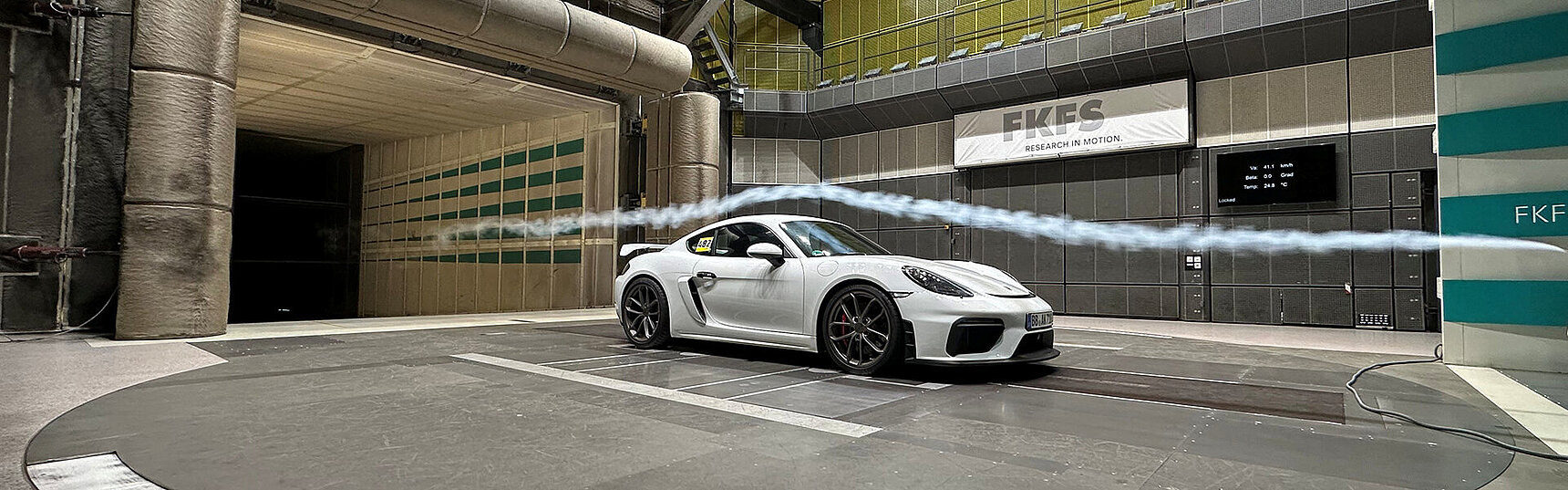
The FKFS aerodynamics and aeroacoustics wind tunnel is among the most capable facilities of its kind in Europe. It is specifically designed for aerodynamic and aeroacoustic investigations of passenger cars, vans, and motorsport vehicles, while flow speeds of up to 260 km/h also allow its use for a wide range of additional applications.
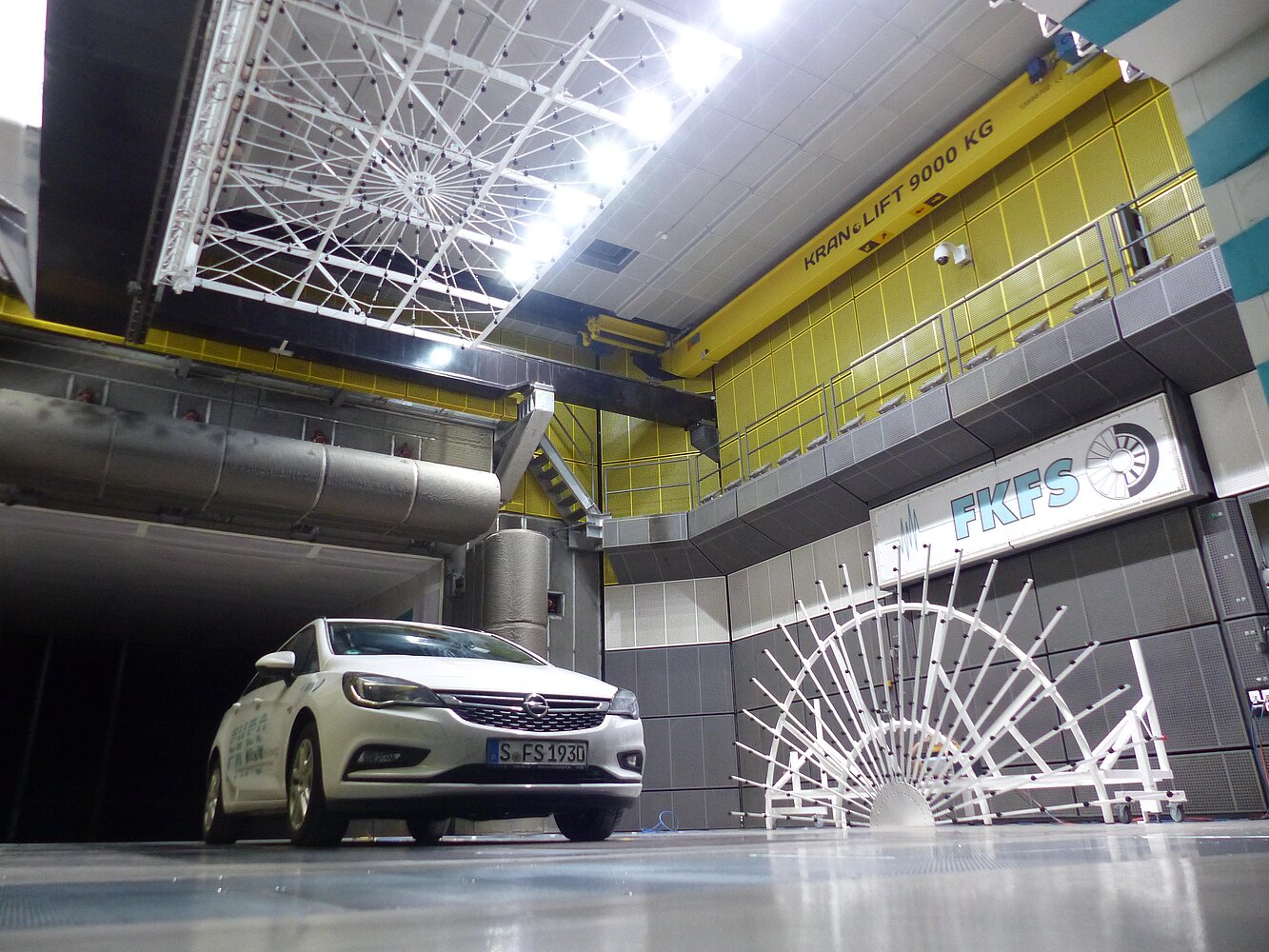
The wind tunnel offers extensive experimental capabilities in both aerodynamics and aeroacoustics. Aerodynamic investigations include, among others, the measurement of forces and moments, the acquisition of surface pressures and flow fields, as well as various flow visualization techniques. Aeroacoustic investigations are based on a broad range of measurement methods, including the use of artificial heads, various types of microphones (e.g. near-field, free-field, and pressure microphones), microphone arrays for sound source localization, as well as complementary vibration and structure-borne noise measurements.
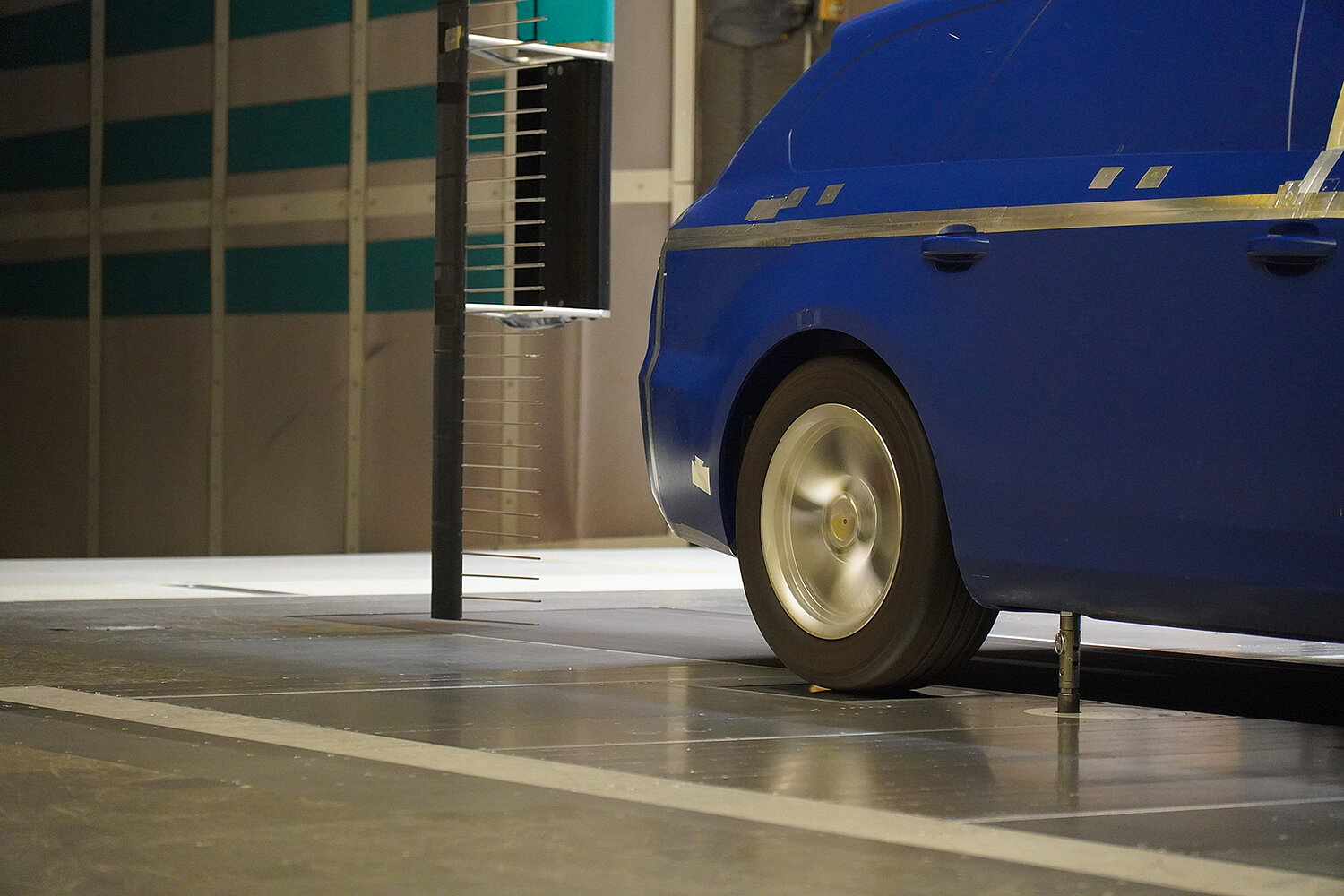
The wind tunnel features a horizontal flow layout with an open-jet test section (Göttingen-type design). A 5-belt system consisting of a central belt and four wheel drive units, in combination with effective boundary-layer conditioning, enables the reproducible simulation of road-representative inflow conditions. Alternatively, a 3-belt system is available in which the entire floor beneath the vehicle is moving, providing optimal conditions particularly for the development of motorsport vehicles. In addition, the FKFS swing system allows the turbulence encountered during real on-road driving to be transferred into the wind tunnel.
Contact
Technical Data
| Dimensions | |
| Dimensions of nozzle (width x height) | 5.8 m x 3.87 m |
| Exit area of nozzle | 22.45 m2 |
| Contraction ratio | 4.41 |
| Length of open jet test section | 9.95 m |
| Diameter of axial fan | 7.1 m |
| Operating output | 3.3 MW (335 1/m) |
| Max. flow velocity | 260 km/h |
Displacement height of boundary layer in the center of the ground plane (x=0) | |
| - without boundary layer influence | 15.5 mm |
| - with boundary layer pre-suction | 7 mm |
| - with road simulation | Block profile |
| Sound-pressure level of empty test section at 140 km/h: | |
| - Out-of-Flow | 64,7 dB(A) |
Application Examples
- Force and surface pressure measurements via moving belt system
- Flow field measurements with Cobra probe
- Total pressure measurements in the wake area of the vehicle model
- Aeroacoustic measurements with intensity probes at the car's surface and in its interior
- Surface vibration measurements with laser vibrometers
- Noise source localization with microphone arrays and an acoustic mirror
- Cooling air volume flow rate measurements
- Measurement of door deflection under wind load
- Ballooning measurements of convertible car roofs
- Frontal area measurements

Accredited Testing Laboratory
Accredited Testing Laboratory
The Vehicle Wind Tunnel (FWK) testing laboratory plays a central role in measuring the aerodynamic drag of vehicles and their components in accordance with Regulation (EU) 2017/1151 and UN Regulation 154. This regulation sets out requirements for type approval and measurement procedures for vehicles in the European Union, particularly with regard to emissions and energy consumption.
Accreditation: